Slop Cloud · Translate
Don’t translate.
Localise.
Your website in every language, written the way a local copywriter of your brand would write it: your voice, your words, your jokes, the way people there actually talk. Sent from WordPress with Slop Lang, the multilingual plugin that weighs next to nothing and was built for search engines first.
Accounts are by invitation only

01 — The difference
Translated is not
localised.
Translation swaps your words for theirs. Every sentence is there, nothing is wrong, and every reader can tell it was written somewhere else. Localisation writes the page again for the people reading it: what each line is meant to do, said the way they would say it.
Most translation tools, plugins and AI buttons stop at the first. Translate is built for the second, because a page that reads translated sells the way a dubbed advert does.
Translation
Swaps the words.
- Your sentences, in the same order, in another language.
- Idioms taken literally, jokes explained or lost.
- Formal on one page, familiar on the next, whichever came out.
- Your product called three different things.
- English quotation marks, dates and numbers, in German.
Localisation
Rewrites for the reader.
- What a local copywriter of your brand would write.
- The idioms and jokes readers there use, rewritten to land.
- Du or Sie, decided once for the brand, on every page.
- Your words, your product names and your taglines, every time.
- „Quotes“, 10.000 € and 9. Oktober, as Germans write them.
From our own kitchen
slop.ee is localised with Translate, from a language guide for every official EU language. Three of its lines show the gap: every word right, the line wrong.
English → German
The receipts.
Translated
Die Quittungen. What a till prints.
Localised
Beweisstücke. Proof, which is what the line means.
English → French
Made with AI. Shipped with AI inside.
Translated
Fait avec l’IA. Expédié avec l’IA à l’intérieur. A parcel, with something in the box.
Localised
Fait avec l’IA. Livré IA incluse. Delivered, AI included, like the batteries.
English → Estonian
Slopping since 2026.
Translated
Sloppi teeme aastast 2026. A stiff workaround for the English -ing. Nobody talks like that.
Localised
Slopime aastast 2026. Slop as an Estonian verb, conjugated like any other.
02 — Your voice
One brand.
Every accent.
A site is translated in the voice of the brand it is written for. If you also have Client Hub, that is your brand’s brief there: its tone of voice, key messages, wording, rules and examples, plus a language guide for each language you write in.
How readers are addressed
Familiar or formal, du or Sie, tu or vous, sina or teie. Chosen once per language, never mixed on one page.
How freely to adapt
Keep close, adapt, or transcreate: headlines, jokes and calls to action written anew, with the facts and promises left exactly as they are.
Your words
The names that stay as they are, the word for each thing in that language, and the words to avoid. Said the same way on every page.
Your key messages
The tagline and the lines you live by, as they are said in that language, used word for word wherever the page says them.
Readers and culture
Who reads it there, what they distrust, which memes they know, which films they saw dubbed and what the dub says.
Conventions
Quotation marks, dates, numbers and money as readers there write them: „…“ and 10.000 € in German, « … » in French.
For agencies
Each connected site chooses whose voice it speaks in: your own brand, a client, one of the client’s projects, or a single topic of theirs. Northwind Roasters’ shop sounds like Northwind Roasters in Finnish, and your agency site sounds like you. The guide is read again for every order, so a change in the brief reaches the next page that is sent.
Without a brand, Translate still writes like a local copywriter. With one, it writes like yours.
03 — What's inside
Written. Edited.
Sent back.
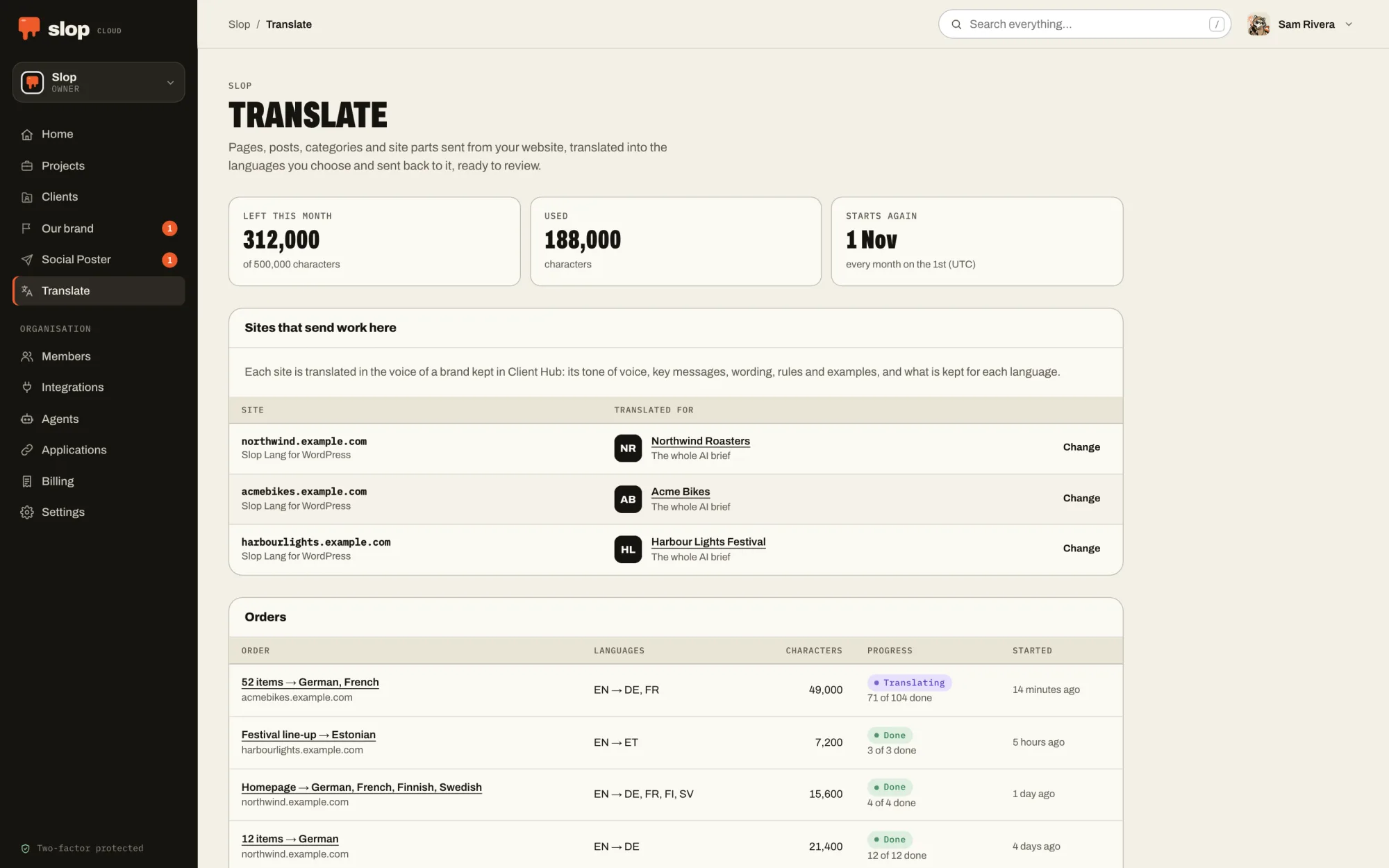
Send a page, a post, a category, the menu or the whole site. Translate writes each language, edits it, and sends it back to the page it came from, in more than 40 languages, right to left included.
A copywriter, not a dictionary
Every request says what each text is on its page: a headline is written anew, a button stays short, a quote stays close, alt text stays plain. The meaning and purpose carry over, never a claim added or left out.
An editor reads it back
A second pass reads each translation the way a reader there would, then against the original and your guide, and rewrites what still sounds translated.
The same words everywhere
A menu, heading or button that appears on many pages is translated once and said the same way on all of them. The short lines it has already said are handed to every request.
Your markup stays yours
Translate never sees your HTML: bold, links and line breaks travel as numbered tags and come back exactly as they went. A text that loses one is asked again, so blocks stay valid and nothing is cut short.
Characters, counted first
Each workspace has characters a month. An order shows what it takes and what is left before it starts; what fails or is stopped is given back. An email comes at 80%, and when they run out.
Legal pages stay human
A privacy policy, terms or an imprint binds the site, so it is never sent to AI. It is recognised by its address or title, in many languages, and translated by a person.
04 — On autopilot
Publish once.
Every language follows.
Turn on automatic translation, and whatever you publish in your own language goes out to the others by itself. Choose the kinds of content and the languages, every language or only some, and whether translations wait as drafts or go live.
01
You publish
A post, a page, a product: in your own language, the way you always do. Nothing else to press.
02
It goes out
A few minutes later, with whatever else was published meanwhile, as one order. If the month’s characters run short, it waits, and the people who look after billing hear about it.
03
It comes back
Every language arrives on its own, as a draft to read or published, as you chose. Then an email says what went live and what waits for you.
05 — Slop Lang for WordPress
Multilingual.
Not heavyweight.
Many multilingual plugins move into your site with luggage: their own database tables, scripts on every page, pages translated again on every visit, a bill paid in speed. Slop Lang carries none of it.
0
Database tables of its own
0
Pages translated on the fly
<5
Kilobytes: the switcher’s style and script
0
Outside calls while a page loads
A translation is an ordinary WordPress page, post or category, stored once and served like any other, so your page cache, your backups and your search treat it as one. Nothing is translated while a visitor waits.
A visitor’s page gets the language switcher’s few lines of style and script, and only where the switcher is. Slop Lang talks to Slop Cloud from your admin and the background, and only once you connect it. Until you add a second language it changes nothing at all.
No build step, no dependencies, block and classic themes alike. It works without Slop Cloud too: translate by hand, and it does the rest.
Everything a site says
- Pages, posts and any other content, with their slugs.
- Categories, tags and the words in addresses.
- Header, footer, templates, menus and patterns.
- Alt texts, captions, the title and the tagline.
- The words your theme and plugins print, cookie banner included.
06 — Search first
Found in
every language.
A translated site that search engines cannot sort out is a pile of duplicates. Every choice in Slop Lang follows what Google, Bing and the AI crawlers document, so each language ranks on its own and none of them costs the others.
In the head of /de/ueber-uns/
<html lang="de">
<link rel="canonical" href="https://example.com/de/ueber-uns/" />
<link rel="alternate" hreflang="en" href="https://example.com/about/" />
<link rel="alternate" hreflang="de" href="https://example.com/de/ueber-uns/" />
<link rel="alternate" hreflang="fr" href="https://example.com/fr/a-propos/" />
<link rel="alternate" hreflang="x-default" href="https://example.com/about/" />
An address per language
Each language lives under its own prefix, /de/ or /et/. Your main language keeps the addresses, links and rankings it has today.
Addresses in the language
Slugs and the fixed words in addresses are translated too: /de/ueber-uns/, /de/kategorie/news/. An old address redirects to the new one.
hreflang, complete
Every page that exists in more than one language names all its versions, itself and x-default in its head. Reciprocal on every version, or Google ignores it.
One canonical per language
Each version points to itself, never across languages. html lang and the feeds’ language are set for every page.
No duplicates, ever
A page not translated yet gets no address in another language: links lead to the original, marked as such. No half-English page under /de/ for Google to cluster away.
Never redirected by guesswork
No redirects by browser language or IP: Googlebot crawls mostly from the US, without a language, and would miss every version but one. Visitors switch with the switcher.
Readable by AI
Everything is rendered on the server, with plain links. GPTBot and ClaudeBot do not run JavaScript, so a switcher made of script is a wall to them. Slop Lang’s is a list of links.
Your SEO texts come along
Titles, descriptions and social texts from Yoast, Rank Math, SEOPress and The SEO Framework go with the page, their variables kept. So do alt texts, captions and the site’s tagline.
A person says yes
Translations arrive as drafts unless you choose otherwise. Google’s spam policies are aimed at automated translation published at scale with nobody reading it.
Slop Lang is not in the WordPress plugin directory: it comes with Slop Cloud. Want it on your site? Feed us a brief.
07 — In the machine
Every market.
Our own voice.
A machine that runs the marketing for brands in many countries has to speak like a local in each of them. Translate is that station: it reads the brand from Client Hub and takes slop.ee abroad in a voice we would sign. People keep the taste and the final yes.
01 — Know
Client Hub
Who each brand is, who it is for and how it talks, compiled into one AI brief that people and agents write from.
02 — Look
CVI
How the brand looks, kept as a brand book: logos, colours, type and pictures that people browse and every agent follows.
03 — See
Moodboards
What the work should look like: pictures, type, colour and references, with notes a model can read and pictures it can see.
04 — Teach
Skills
How the work is done, written once as skills that every AI agent in the company picks up and follows.
05 — Plan
Social Media
What goes out when: queues that post at their weekly times, a calendar, approvals, and how every post did afterwards.
06 — Serve
Social Poster
Posts and threads drafted, polished and published to every connected account at once, after a person says yes.
07 — Speak · You are here
Translate
The website in every language, localised in the brand’s own voice: sent from WordPress with Slop Lang, back as drafts to review.
08 — Measure
SEO Audits
Whether the right people can find the work, measured against the searches they make, and what to fix first.