
For years I have been itching, and annoying many of my friends in marketing, with my excitement about all the new possibilities AI opens up. But it always stayed just that: me, overexcited about yet another thing AI can do.
Meanwhile, every day I work on all kinds of sales and marketing pieces across my different responsibilities. A sales tool here, an agent for ads management there, a “smart” campaign somewhere in the middle, a content tool somewhere else. Each one useful in its own corner. None of them part of a larger picture.
Then, just recently, it finally dawned on me. First, all these things can be connected, and with slight adjustments made reusable. Second, my responsibilities are growing so fast that I can’t keep doing it this way for long anyway.
So we’re bringing all of that marketing work under a single roof, with one clear vision that works for every brand and company involved. That roof is Slop.
Slop is Kempu’s in-house studio with an unusual job description: build the machines that do the marketing, then find out how far they can take it. On screens, and off them. We make brands, websites and content, and run social media and ads, for the Kempu brands first, and take on outside projects when they stretch us somewhere new. That part sounds like any studio. What we’re really here for is the question underneath it: how much of marketing can AI actually do, and what becomes possible once it does?
From loose pieces to one machine
Most teams use AI the way I used to: to go faster at the work they already do. A quicker first draft, a few extra variants, an afternoon saved. Useful, but it leaves the shape of the work exactly where it was, and every tool stays stuck with the brand it was built for.
We want to change the shape. Our goal is to build AI systems that can carry most of the marketing work across all our brands from end to end: the research, the drafts, the variants, the sites, the campaign plumbing, the reporting. Not a clever tool here and there, but one connected stack of models and agents that runs the routine, while people spend their time on judgement and taste. Build it once, tune it per brand, reuse it everywhere.
We’re not just using AI to make marketing. We’re building the AI that makes it.
What “most of the work” looks like
Picture a launch. Today it takes a room full of people a few weeks. The version we’re building towards looks more like this:
- Research that runs itself. Agents read the market, the reviews and the support tickets, and hand us a brief worth arguing about.
- Content at machine speed. Copy, images and video in every size and language, generated in hours and tuned to each brand’s voice.
- Sites that keep working. Pages that answer questions, adapt to who is reading and rewrite themselves when something stops converting.
- Campaigns on autopilot. Scheduling, testing and reporting handled by systems that tell us what happened and what to try next.
People stay where they matter most: deciding what’s worth saying, choosing the direction, and giving the final yes. The machines do the typing. We do the tasting.
Then, further
Automating today’s marketing is only the first half. Once the routine runs itself, the more interesting question is what marketing can do that it never could before.
That’s why we ship AI inside the work, not just behind it. A website that holds a real conversation. Content that shapes itself around one person instead of an average. Products whose marketing and features blur into the same thing. Each case study on this site has an “AI inside” tag where a model ships with the finished work, and we want that tag on nearly everything we make.
Off the screen
Marketing doesn’t only happen in a browser, and neither should AI. The next frontier we care about is the physical world: the places people actually stand, touch and look.
Think packaging and print generated for the moment instead of the season. Displays and installations that see the room and respond to it. Event spaces where machines are part of the show, not hidden in the back office. Physical objects designed, varied and produced with models in the loop. Some of this is ready today and some of it isn’t yet, which is exactly why we want to be the ones finding out.
Why in-house makes this possible
This kind of work needs patience and a place to test it. An outside agency has to show results in the next deck; we get to build systems that pay off over years. We know the Kempu products, people and history, so our experiments start with real problems instead of hypothetical ones.
The Kempu brands are our lab and our first customers. Under one roof, whatever we build for one brand is ready for the next one the day after. When something works, it ships to real products and real customers. When it doesn’t, we’re the ones still here on Monday, fixing it. That shared skin in the game is what lets us make ambitious bets without making reckless ones.
How we keep ourselves honest
More AI is not the goal. Better marketing is. Three rules keep us pointed at that:
- A human signs off. Every batch is tasted by a person before it reaches anyone. The slop is intentional; the mistakes are not.
- Helpful beats impressive. A system earns its place by solving a real problem for a real person, not by being a good demo.
- Show the working. We write down what we build, what works and what breaks, so the lessons outlive the experiment.
Follow along
This blog is where that writing goes. Expect working notes on the systems we build, the models we ship inside products, the experiments that leave the screen, and the ones that fail on the way. No filler, no jargon for its own sake, and not a single “in today’s fast-paced world.”
Now and then, what we make along the way will be actual slop. That comes with testing and learning in the open: every bad batch teaches the next one, and the only way to get good at this is to keep making it.
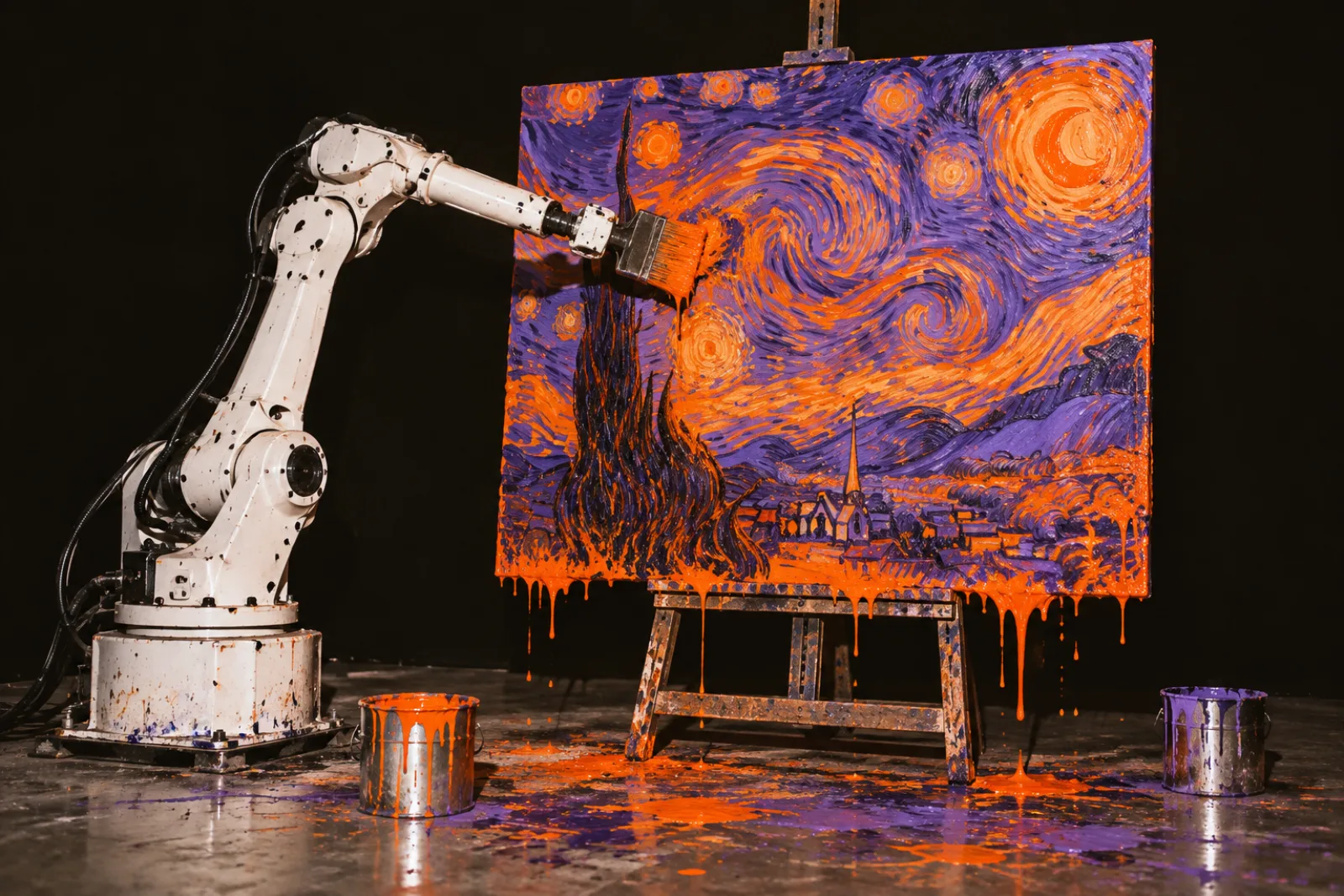
If you hear a voice within you say “you cannot paint,” then by all means paint, and that voice will be silenced.
Vincent van Gogh
If you want to see how far marketing can go with machines doing most of the work, subscribe via RSS and watch it happen.